A child’s first weeks in a new setting shape how they feel about it for a long time. So do their parents’. A parent who leaves in tears and hears nothing until 18:00 has a long day too.
Settling in usually goes wrong in small ways: a timetable that suits the rota rather than the child, a parent told to slip away while their child is busy, a key person chosen on the first morning, a first week with no news.
This guide covers:
- getting to know the child and family before the first day;
- choosing the key person before the start;
- planning settling-in sessions around the child;
- the goodbye;
- keeping parents informed in the first days;
- signs a child is settling, and signs they aren’t;
- children who need longer;
- room moves and starting school;
- reviewing with parents after the first few weeks.
1. Get to know the child before the first day
The more you know before the first morning, the less a child has to tell you with tears.
Offer a visit before the start. Some settings visit families at home. Others invite them in, at a quiet time, more than once. A home visit lets the child meet their key person on their own ground. A visit to the setting lets them see the room, the toys and the faces before they have to stay. Either works. Offer the one you can do well.
Then have the “all about me” conversation with the parents. Ask, and write down:
- Routines. When they wake, eat and nap, and how a day usually goes at home.
- Comfort. A comforter, a dummy, a song, a way of being held. What helps when they are upset.
- Words. What they call their parents, brothers and sisters, the toilet and their comforter. How they say they are hungry, tired or hurt.
- Sleep. How and where they sleep, and what helps them drop off. For babies, follow your safer sleep policy.
- Food. What they eat and drink, and how: bottle, cup, spoon or fingers. Anything they won’t touch.
- Languages. Which languages are spoken at home, and by whom. A few words in the child’s home language — hello, drink, home, the names they use for their parents — go a long way.
- Health and allergies. Allergies, medical conditions and medicines, and who their health visitor and GP are.
- Who collects. Who will bring and collect them, and anyone who must not.
- What they love. Favourite toys, songs, animals and games, and anything that frightens them.
Ask the parents what they are worried about. Their answer often tells you more than the form.
What to do: Book a visit for every new child before their first session. Use one “all about me” form for every family, go through it together rather than sending it home to fill in alone, and share what it says with everyone who will care for the child.
2. Choose the key person before the start
A child settles with a person, not a room. The key person is the adult who gets to know the child best, comforts them, and is the parents’ first point of contact.
- England. The EYFS statutory framework says each child must be assigned a key person. Their role includes helping the child become familiar with the setting and building a relationship with the child’s parents.
- Scotland. Each child must have a personal plan within 28 days of starting, made with the family and reviewed at least every six months. The settling-in conversations are where it begins.
- Wales. Check what the National Minimum Standards for Regulated Childcare expect for each child’s care and for settling in.
- Northern Ireland. Check what the Minimum Standards for Childminding and Day Care for Children Under Age 12 expect for each child’s care and for settling in.
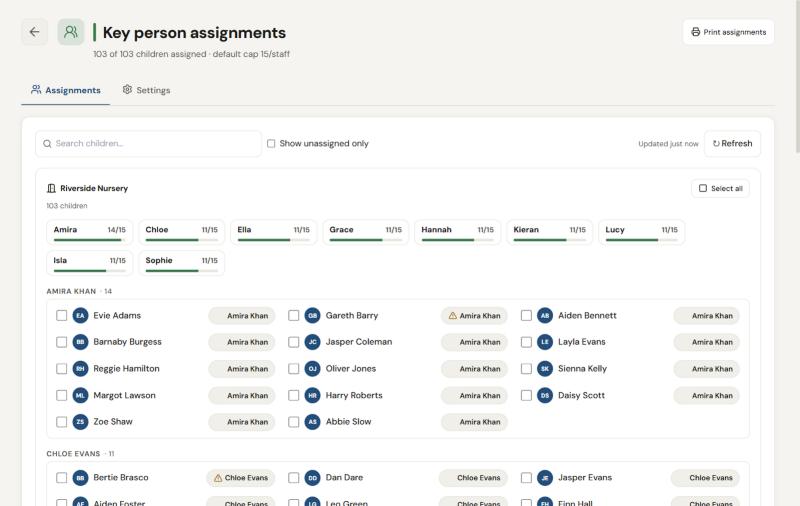
Choose the key person before the first day, and tell the family their name. Where you can, that person does the visit, the first goodbye and the first message home. Name a second person too, for the days the key person is off. A child with nobody familiar on their third morning has to start again.
If you are a childminder, you are the key person. The rest of this guide still applies.
What to do: Assign a key person and a back-up for every new child before they start, and check both are on the rota for the child’s first sessions. Tell the parents who they are, and introduce them at the visit.
3. Plan settling-in sessions around the child
Many settings have a usual settling-in pattern: an hour with a parent, an hour without, a morning, then a full day. It is a useful starting point. It isn’t a timetable the child has to keep to.
Build up gradually:
- Short visits with a parent staying. The child plays, the parent stays close, and the key person joins in.
- The parent steps back. Still in the room or nearby, while the key person does more of the caring.
- A short time apart. A few minutes at first, then longer. The parent says goodbye and comes back when they said they would.
- Longer sessions, including a meal, and a sleep if the child will sleep with you.
- Their usual sessions.
Move to the next step when the child is ready, not when the plan says. Some children are ready in a few days. Some need weeks. Going back a step is fine, and often quicker in the end than pushing on.
Settling in takes the parents’ time too. Before they fix a start date, tell them how many sessions to expect, whether you charge for them, and that it may take longer. A parent who has to be back at work on Monday needs to know that now, not on Friday.
What to do: Write your settling-in steps down as a guide, not a timetable. Agree the first few sessions with each family, then decide the next step together after each one. Tell families before they fix a start date that settling in may take longer than planned.
4. Say goodbye, don’t sneak out
Slipping out while a child is busy looks kinder. It usually isn’t. A child who turns round and finds their parent gone may start to watch the door, and hold on harder the next time.
A good goodbye is short, clear and the same each time:
- the parent tells the child they are going, and when they’ll be back, in words the child knows: “after lunch”, “after your sleep”;
- a goodbye ritual: a hug, a wave at the window, a kiss on the hand to keep;
- the parent hands the child to the key person, then goes;
- no going back for one more cuddle once they’ve said goodbye.
Crying at goodbye is common, and it doesn’t mean settling in has failed. What matters is what happens next. Does the child let the key person comfort them, and how long is it until they are playing?
Parents find this hard. Tell them it is normal for a child to cry, that you will comfort them, and that you will let them know how they are. Then do.
What to do: Agree a goodbye routine with each parent before the first time they leave. Be with the child yourself as the parent goes. Ask parents not to sneak out, and explain why.
5. Keep parents informed in the first days
The hardest part of a parent’s first day apart is not knowing. A short message changes it.
- Send something early. Soon after a first separation, a line from the key person: “Ava cried for a few minutes after you left. She’s at the water tray now, filling cups.” A photo of the child settled says it best, where the parent has agreed to photographs. Leave other children out of the picture.
- Be honest when it was hard. If a child didn’t settle, say so, kindly, and say what you did. A parent told “fine” who later hears otherwise stops trusting the messages that follow.
- Tell them how the day went at collection. Eating, sleep, nappies, play, what they enjoyed, and anything to try tomorrow.
- Ask what is happening at home. Some children show how they feel about a new setting at home first: tiredness, clinginess, sleeping differently. Tell parents this is common, and ask them to tell you.
What to do: Make a message home part of every first separation, sent by the key person. Agree with each parent how they would like to hear from you — a message, a photo or a call — and how often in the first week.
6. Know the signs of settling, and of not settling yet
Settling isn’t the same as not crying. A child can be quiet and not settled, or cry at the door and be happy five minutes later.
Signs a child is settling:
- they go to their key person for comfort, and let them help;
- they play and explore, and come back to their key person to check in;
- they eat and drink with you, and sleep if they sleep with you;
- they stop crying soon after their parent leaves, and that time gets shorter;
- they start to show you what they want, and to join in.
Signs a child isn’t settling yet:
- they can’t be comforted, or are still very upset long after their parent has gone;
- they stay withdrawn, watch without joining in, or won’t leave one spot;
- they won’t eat, drink or sleep with you;
- their parents tell you of big changes at home: sleep, eating, clinginess, going backwards with toileting;
- they seemed fine for the first week or two, then found it harder. This happens often once the newness wears off.
Write down what you see after each session: how long they were upset, what helped, what they ate, how they slept. A few lines a day show you the trend, and give you something real to share with parents.
What to do: Have the key person write a short note after each settling-in session. If after a few weeks a child isn’t showing signs of settling, talk to the parents and agree what to change, rather than waiting it out.
7. Give some children longer
Some children need more time, a different plan, or both. Plan for that from the start, not after a hard fortnight.
- Children with SEND. Ask the parents what helps, what doesn’t, and who else is involved: a health visitor, a speech and language therapist, a portage worker. With the parents’ agreement, talk to them before the start. Involve whoever leads on SEND in your setting. Some children settle better with a quieter room, a visual timetable, a photo of their key person to look at home, or exactly the same routine every time.
- Children learning English as an additional language. Learn key words in their home language, ask parents to teach you the words for comfort, food and the toilet, and use gestures and pictures. A child who can’t understand you, or make themselves understood, has more to cope with. In England, the EYFS statutory framework asks settings to give children whose home language isn’t English the chance to use it in play and learning.
- Children who have had a hard start. A looked-after child, a child who has been adopted, a child who has lived through a bereavement, a serious illness, a family separation or a move from another country. A new carer may be harder for them to trust. Go slowly and keep the same faces. With the agreement of whoever has parental responsibility, talk to the professionals who know the child. Make sure your designated safeguarding lead knows about any child with a social worker.
- Older children starting a club. School-age children settle too. Let them visit, introduce one member of staff who will look out for them, and show them where things are and who to ask.
What to do: At the “all about me” conversation, ask every family whether anything might make settling in harder for their child. Where it might, write a settling-in plan with the parents, with more steps and more time, and look at it together each week.
8. Use the same approach when children move on
Settling in doesn’t happen only once. A new room, a new key person or a new school is a new start, and the same steps help.
- Room moves. Visit the new room with someone the child knows, for short times, before the move. Pass on what the current key person knows: routines, comfort, words, what helps. Tell parents the date and the new key person’s name well before. Where you can, move a child when they are ready, not only when they reach an age, and don’t change everything at once.
- Starting school. Talk to parents early about what will help. Invite the child’s new teacher to visit, where the school offers. Talk with the child about school through books, play and photos of the new building. Share what the school needs to know, with the parents’ agreement.
What to do: Make a short transition plan for each room move and each child starting school: visits, a handover from key person to key person, and a date the parents know in advance. Ask the family before you share anything with a school.
9. Review it with the parents after the first few weeks
Settling in ends when the child is settled, not when the settling-in sessions stop. A few weeks after the start, sit down with the parents and look back together.
Talk about:
- how the child is now: at drop-off, through the day and at home;
- what they enjoy and what they still find hard;
- what you have learned that wasn’t on the “all about me” form;
- anything the parents are still worried about;
- what happens next, and how you will keep in touch.
Update the child’s records with what you learn. In Scotland, it is a natural time to finish or check the personal plan, if it isn’t already in place. Ask the parents, too, how settling in felt for them, and what you could do better for the next family.
What to do: Book a settling-in review with each family before the child starts, for a few weeks in. Write down what you agreed, and use what families tell you to change your settling-in approach.