The alarm goes at 13:20. Four babies are asleep in the cot room, two members of staff are on their lunch break, a plumber is under the kitchen sink and a parent has just come in to collect early. Everyone needs to get out, and someone at the assembly point needs to know that everyone has.
Most settings practise. The gaps are in the detail: drills always at 10:00 on a dry morning, a register nobody updated when a child went home, an agency worker who doesn’t know where the assembly point is, an evacuation cot nobody has checked.
This guide is not fire safety advice for your building. Your fire risk assessment, your local fire and rescue service and your regulator’s guidance come first. It covers:
- your fire risk assessment, and who is responsible for it;
- planning how every child gets out, including babies and children with SEND;
- knowing who is in the building right now;
- practising at the hard times;
- the roll call, and what to do if someone is missing;
- recording each drill, and acting on it;
- checking the fire equipment;
- training staff, including agency staff;
- telling parents.
1. Start with your fire risk assessment
Everything else in this guide rests on it. A fire risk assessment looks at what could start a fire, who would be at risk, and how they would get out. Your evacuation plan, your drills and your equipment checks all follow from what it finds.
The law puts the duty on a named person or organisation for the premises. The law, and the name for that person, differ by nation:
- England and Wales: the Regulatory Reform (Fire Safety) Order 2005. The duty sits with the “responsible person”: usually the employer, or whoever controls the premises.
- Scotland: the Fire (Scotland) Act 2005 and the Fire Safety (Scotland) Regulations 2006, which call them the “dutyholder”.
- Northern Ireland: the Fire and Rescue Services (Northern Ireland) Order 2006 and the Fire Safety Regulations (Northern Ireland) 2010, which call them the “appropriate person”.
If you share a building, such as a church hall or a school, more than one person may have duties. Agree in writing who looks after what: the alarm, the exits, the equipment, and what happens when another group is using the building at the same time. If you run a club at a hired venue, ask for the venue’s fire plan, and a briefing on its alarm, exits and assembly point, before your first session.
You can carry out the assessment yourself if you are competent to, or ask a qualified fire risk assessor. Either way, write it down and keep it where staff can find it. Review it regularly, and whenever something changes: a new room, building work, more children, a child with new needs, an exit you can no longer use.
What to do: Find your fire risk assessment and check its date. If anything has changed since it was written, review it now. Put the next review in the diary, and be sure you know who holds the legal duty for your building.
2. Plan how every child gets out
A plan that works for a room of four-year-olds won’t work for a room of babies. Plan room by room, and name who does what.
Babies and children who can’t walk.
- Evacuation cots. Many baby rooms use a cot on wheels that carries several babies at once. Check it goes through every door on the route, that nothing is ever parked in front of it, and that staff have practised loading it.
- Who carries whom. Decide which adult takes which babies, and how many each can manage safely. Write it on the room’s plan, and change it when the rota changes.
- Sleeping children. Don’t stop for shoes, coats or nappies. Keep blankets by the exit, or in a grab bag, so children can be kept warm outside.
Children with SEND. A child who uses a wheelchair, has a hearing or sight impairment, is frightened by the noise, or may run or hide, needs a plan of their own. A personal emergency evacuation plan (PEEP) says what help they need, who gives it, any equipment, and the route. Write it with the child’s parents, and review it as the child grows. Some children cope better when they have heard the alarm before, or seen a picture story of what happens. Staff can need a PEEP too: someone pregnant, injured or with a disability.
Routes and places.
- Know at least two ways out of every room, where the building allows.
- Choose an assembly point away from the building and out of the way of fire engines, with a second one in case the first can’t be used.
- Agree a place of safety indoors nearby, such as a neighbouring building, in case you can’t go back in for a long time. Young children can’t stand outside in the cold for long.
What to do: Walk the route from each room at the pace of your slowest child, with the cot or the buggy. Write a one-page plan for each room: the exits, who takes which children, what equipment goes, and where you meet. Put it by the door.
3. Know who is in the building right now
A roll call is only as good as the list it starts from. At the assembly point you need to know who should be there: every child, every adult and every visitor.
- Children: the register. It only works if it is kept up to date: children signed in when they arrive, out when they leave, and moved when they change room. A child who went home at 12:00 and wasn’t signed out sends someone looking for a child who isn’t there. A child who arrived late and wasn’t signed in isn’t looked for at all.
- Staff: signing in, or clocking in. Every adult working, including students, volunteers, agency staff, and anyone on a break or in the office.
- Visitors: a signing-in record. Everyone who isn’t on staff signs in and out: contractors, visiting professionals, a parent staying for settling in, a family looking round. Tell each one on arrival what to do if the alarm sounds, and who to follow.
Whatever you use has to leave the building with you. A sheet on a clipboard by the exit, or a phone or tablet someone is responsible for picking up, and the children’s emergency contacts. A register kept on one office computer stays behind in a fire.
What to do: At a moment nobody expects this week, check the register against the rooms. Does every child signed in match a child in the room? Fix the gap you find, whether it is signing in, signing out, or room moves. Make one named person on each shift responsible for taking the list out.
4. Practise at the hard times
Hold drills regularly, at different times of day and with different staff on duty. In England, the EYFS statutory framework expects you to have an emergency evacuation procedure, and for fire drills to be carried out and recorded. In Scotland, Wales and Northern Ireland, your regulator’s standards and your fire risk assessment set what is expected. Check your own, and don’t take a frequency from another nation or from a template.
A drill at 10:00 on a dry morning with the manager in the building tells you very little. Plan the ones that test you:
- Nap time. Sleeping children, a darkened room, fewer staff awake to the room.
- The busiest time. Drop-off or collection, with parents in the corridor and coats everywhere.
- Mealtimes. Children at the table, and the kitchen in use.
- Outdoor play. Can the alarm be heard in the garden? Who brings in the children who are outside, or takes them straight to the assembly point?
- Early and late. The smallest staff team, perhaps with the manager not in.
- An exit out of use. Tell staff, as the drill starts, that one exit is blocked.
- Someone missing. With your knowledge, ask a member of staff to stay out of sight in a safe place, and see what happens when the count comes up short.
Once staff know the routine, stop telling them when it is coming. A drill everyone knew about practises the route. An unannounced one tests the plan. If your alarm is monitored, tell the monitoring company first, and tell anyone you share the building with.
What to do: Plan the year’s drills now, each at a different time, in a different room and with a different mix of staff. Keep the dates to yourself and one other person.
5. Count everyone at the assembly point
Getting out is half the job. The other half is knowing, quickly and for certain, that everyone is out.
Name an evacuation lead for every session, and a deputy for when they are off, on a break or in another part of the building. At the assembly point:
- The lead takes the list: the register, staff signing-in and visitors.
- Each room reports: the children with them, and anyone they know is somewhere else, such as in the toilet, in the garden or collected early.
- The lead checks every name against the list, children, staff and visitors.
- Children stay together, calm and as warm as you can keep them. Don’t hand a child to a parent who arrives until the count is finished and written down.
- Nobody goes back in until the fire and rescue service says it is safe.
If someone is not accounted for:
- Don’t go back in to look. Call 999 if nobody has yet. When the fire and rescue service arrives, tell them who is missing, where they were last seen, and any needs they have.
- Check the obvious quickly: a child signed out but still on the list, a child with another room’s group, a member of staff who went out to the car park.
- In a drill, stop the drill, find the person, and record it as a finding.
After a real evacuation, check whether your regulator needs to know. Each nation sets out its own list of events to notify, and when. Don’t assume England’s rules apply.
What to do: Put the steps on the back of the roll call sheet, including what to do if someone is missing. Practise the count until it is routine, and make sure every lead and deputy has run one.
6. Record every drill, and change what didn’t work
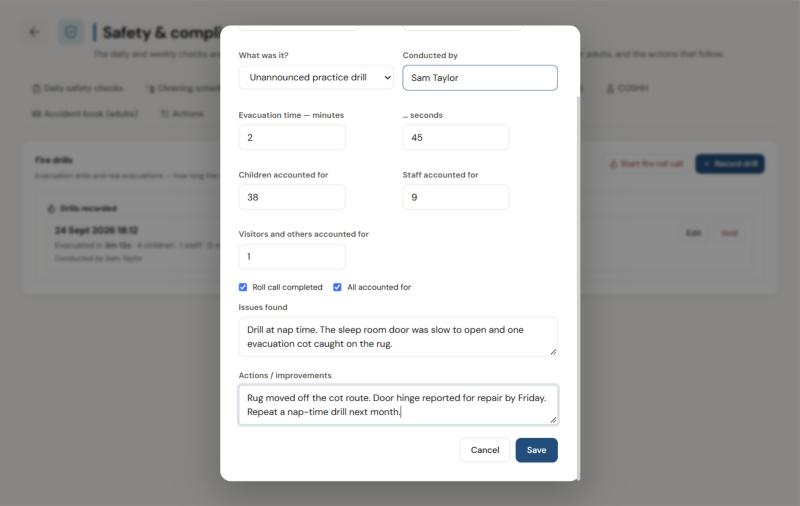
A drill that isn’t written down can’t show that you practise, or what you learned. For each drill, record:
- the date and the time;
- what it was: a planned drill, an unannounced drill or a real evacuation;
- how long it took to get everyone out, and to finish the count;
- who took part: the rooms, the number of children, staff and visitors, and who led it;
- whether everyone was accounted for;
- what went wrong;
- what you changed, who is doing it, and by when.
Write down problems, not blame. “The baby room’s outer door stuck”, not a member of staff’s name.
Time each drill the same way, so you can compare one with the next. Don’t take a target time from a template. If a time worries you, ask your fire risk assessor or your local fire and rescue service.
Then make the change, and check at the next drill that it worked. The most useful line in the record is the one that says what you changed.
What to do: Read last term’s drill records together. Did the same problem come up twice? Was every room, time of day and shift covered? Pick the next drill to test whatever looks weakest.
7. Check the equipment, and know who checks it
Your fire risk assessment, the manufacturers’ instructions and the British Standards for fire alarms (BS 5839-1) and emergency lighting (BS 5266-1) set what is checked, and how often. Some checks are yours to do. Others need a competent person, usually a contractor.
- Fire alarm. A test from a call point, using a different one each time, by your own staff. A service by a competent person.
- Emergency lighting. A short test by your own staff. A full test by a competent person.
- Extinguishers and fire blankets. A look by your own staff: in place, seal intact, gauge in the green. A service by a competent person.
- Fire doors. They close fully on their own, nothing wedges them open, and their seals and signs are in place.
- Exits and routes. Clear, signed, and the final exits open easily from the inside.
- Evacuation equipment. The cot’s wheels and brakes, any evacuation sledge, the grab bag, torches, and an up-to-date list of emergency contacts.
In England, the EYFS says fire detection and control equipment must be in working order, fire exits must be clearly identifiable, and fire doors must be free of obstruction and easily opened from the inside. Check what your own nation’s standards say.
Name a person for each check you do yourselves, and a deputy for holidays. Record each one: the date, who did it, what was tested, the result, and what was done if something failed. Keep the contractors’ certificates with the records. A failed check needs an owner and a date to be put right, the same day it is found.
What to do: List every check, with who does it and who covers. Keep them in one log book, with the drills. When something fails, agree who fixes it and by when, and check the fix.
8. Train every adult, including agency and bank staff
A plan only works if every adult in the building knows their part. Staff learn it at induction, before they are counted in ratio:
- what the alarm sounds like;
- the exits from their room, and the assembly point;
- which children they take, and where the evacuation cot and grab bag are;
- how the roll call works, and who leads it;
- that nobody goes back in;
- what to do if they discover a fire. In most settings that means raising the alarm and getting out. Only staff who are trained should use an extinguisher, and only if it is safe and the way out stays clear.
Agency and bank staff, students and volunteers need the same briefing at the start of their first shift, and again when they move to a new room. Keep a record that each person had it. They are on the roll call list too.
Train your evacuation leads properly, and give everyone a refresher regularly and whenever the plan changes. A new exit, a new room or a new evacuation cot means a new briefing.
What to do: Write a one-page fire briefing for each room. Give it to every new adult on their first day, ask them to sign that they have read it, and walk them along the route.
9. Tell parents what to expect
Parents should know before a drill happens, not find out from an upset child.
- When a child starts, tell parents that you practise evacuations regularly, including unannounced and at nap time, and that children may be taken outside in any weather. Tell them where the assembly point and the place of safety are, and how you will contact them in an emergency.
- Keep emergency contacts up to date. Ask parents to tell you straight away when a number changes, and check the list each term.
- After a drill, many settings let parents know it happened, so they can talk about it at home. That matters most for a child the alarm frightened.
- After a real evacuation, tell every family promptly: what happened, that their child is safe, and where to collect them if you have moved to the place of safety. One clear message from you stops the rumours.
- Parents in the building when the alarm goes follow staff to the assembly point, and don’t go back in for a child’s bag or coat.
What to do: Add a short paragraph on fire safety to your parent handbook. Draft the message you would send after a real evacuation now, so nobody writes it from scratch on the day.