A child trips in the garden and grazes a knee. Another arrives on Monday with a bruise nobody mentions. A third bumps their head on a table edge just before lunch. Each one needs a record. One needs a phone call to a parent within minutes. One may need your safeguarding lead.
Most settings have an accident book. The trouble is usually what goes in it: written up at the end of the day, short on facts, acknowledged by a parent in a hurry at the door, then filed and never read again.
This guide covers:
- what counts as an accident, an injury and an incident;
- injuries a child arrives with;
- writing a good record at the time;
- telling parents and getting their acknowledgement;
- head injuries, and when to get help;
- spotting patterns, and when a pattern is a safeguarding concern;
- who outside your setting must be told;
- keeping records, and for how long.
1. Agree what counts
Staff record what they think counts. If one person writes up every graze and another only writes up the ones that bleed, your records tell you about your staff, not your children.
Agree the words, and give examples:
- Accident. Something unplanned that hurts a child, or could have. A fall, a trapped finger, a collision in the garden.
- Injury. The harm itself. A graze, a bruise, a bite mark, a burn, a cut.
- Incident. Something that needs a record but may not involve an injury. A child taken ill, a near miss, a medication error, a child who left a room unnoticed, behaviour that hurt someone, damage to the premises.
- Existing injury. A mark or injury a child already has when they arrive (see section 2).
Near misses matter more than they look. The broken gate that nobody walked through yet is where the next accident will happen.
Adults have accidents too. Keep a separate record for staff, visitors and parents, because some of those may need reporting (see section 7).
What to do: Write your definitions and examples into your accident and incident policy, and go through them at induction, including with bank and agency staff. Tell staff plainly: if in doubt, record it.
2. Record injuries a child arrives with
A bruise noticed at a nappy change, and not recorded, causes two problems. Nobody can later say whether it happened at home or with you, and a pattern across weeks is never seen.
When staff notice a mark or injury a child arrived with:
- Ask the parent, calmly and without accusing. “I noticed a bruise on Ava’s arm. Did she tell you how she did it?” Most answers are ordinary.
- Record what you see. Where on the body (a body map helps, with which side), the size, the colour, and whether the skin is broken.
- Record what the parent said, in their words. Not a summary.
- Record the time, and who noticed it.
- Ask the parent to read and acknowledge the record.
Don’t question the child with leading questions. If a child tells you something themselves, write down exactly what they said. Follow your safeguarding policy on photographs. Many settings never photograph a child’s injury and use a body map instead.
If the explanation doesn’t fit the injury, changes, or there is none, tell your designated safeguarding lead the same day. The decision about what happens next is theirs.
What to do: Keep an existing injury form, with a body map, where staff can reach it at drop-off. Practise the conversation with the parent at a staff meeting, so nobody sounds suspicious and nobody lets it pass.
3. Write the record at the time
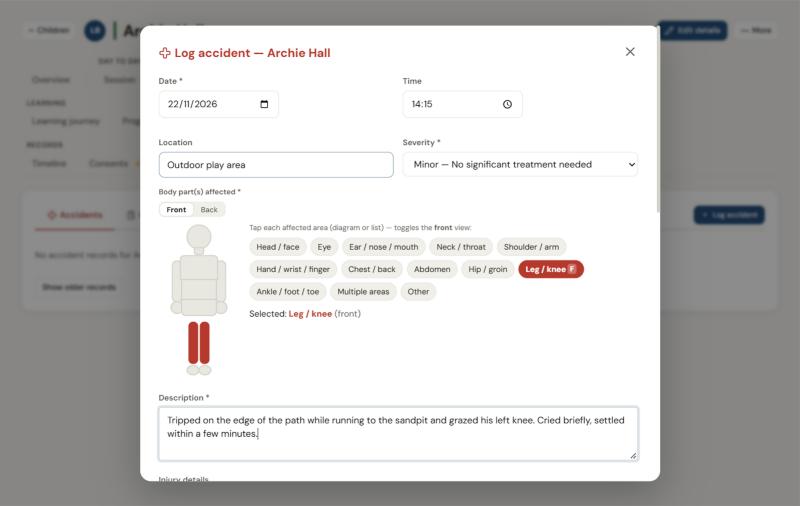
A record written at 17:45 from memory is weaker than one written at 10:20 by the person who saw it. Write it the same day, as soon as the child is settled, by the member of staff who saw it or dealt with it.
A good record has:
- the child’s name, the date, the exact time and the place;
- what happened, in order, in facts: what you saw, not what you assume. “Ava tripped on the edge of the mat and fell forward onto her hands”, not “Ava was being silly”;
- the injury: where on the body, which side, the size and what it looks like;
- the first aid given, by whom and when;
- who saw it happen, and who was looking after that area;
- who wrote the record;
- when the parent was told, and by whom.
When more than one child is involved, such as a bite, each child gets their own record. Leave the other child’s name out of anything their parent will read. It is another family’s personal data.
Don’t rewrite a record later. If something changes, such as a parent telling you the next day that they took their child to hospital, add a dated note underneath. The original stays as it was written.
What to do: Take three records from last month and read them as a stranger would. Could someone who wasn’t there tell what happened, where the injury is and what you did? If not, change your form and retrain, rather than tidying the old records.
4. Tell parents the same day, and get their acknowledgement
In England, the EYFS statutory framework says you must tell parents about any accident or injury to their child, and any first aid given, on the same day or as soon as reasonably practicable. The standards in Scotland, Wales and Northern Ireland also expect you to keep parents informed. Check the wording in yours.
How you tell them matters as much as when.
- Tell them yourself. The best person is the one who saw it or gave first aid. A parent should not learn about an accident from a plaster at pick-up.
- Phone straight away for anything more than minor. A head injury, anything that might need medical advice, anything a parent would want to know at work. Set the rule so staff don’t have to guess.
- Ask the parent to read the record and acknowledge it. Make clear that acknowledging means they have been told, not that they agree with every word. They can still raise questions.
- Note how and when they acknowledged it, in person or in writing. If a parent won’t acknowledge it, record that you told them, and when.
- Offer them a copy.
What to do: Write down when staff phone a parent and when they tell them at collection. Once a week, check for records with no acknowledgement, and follow each one up.
5. Treat every head injury as a phone call
Head injuries are common in young children, and most are minor. A few are not, and the signs can appear later. This section is not medical advice. Follow your paediatric first aid training and the NHS’s guidance on head injuries.
- Phone the parent straight away, however small the bump looks. Record when you called and who you spoke to.
- Watch the child closely, and record your checks with the time of each.
- Know the signs that mean an ambulance. Your first aid training covers them. Put the NHS list where staff can see it in every room.
- If in doubt, get help. Call 999 in an emergency. For urgent advice, call NHS 111 in England and Wales, or NHS 24 on 111 in Scotland. In Northern Ireland, use your GP or the out-of-hours service.
- Give the parent the head injury advice to watch for at home, in writing.
Any member of staff can call 999. They should not wait to find the manager first.
If a child goes to hospital, the accident may need reporting outside your setting (see section 7).
What to do: Agree with your team that a head injury always means a phone call to the parent and timed checks. Say in your policy that anyone may call 999 without asking first.
6. Look for patterns
One record tells you what happened. A month of records tells you why.
Read them together and look for:
- The same place. A step, a corner of the garden, a table edge. Fix the hazard and update your risk assessment.
- The same time. Late morning before lunch, the last hour, a handover. Tired children and thin staffing both show up here.
- The same child. Frequent accidents can point to a child who needs support: coordination, eyesight, a developmental need. Talk to the parents and to whoever leads on additional needs in your setting.
- The same adult on duty. It may be a training need, or a staffing gap.
Some patterns are safeguarding concerns. Tell your designated safeguarding lead the same day if you see:
- frequent injuries a child arrives with;
- explanations that change, don’t fit the injury, or are never given;
- injuries in places children don’t usually hurt in everyday falls;
- a delay between an injury and anyone seeking help;
- injuries that keep happening when the same adult is in charge.
Don’t investigate it yourself. Record what you saw and pass it on. The designated safeguarding lead decides what happens next.
What to do: Once a month, have a manager read every accident and incident record together. Note the place, the time and the children involved. Fix hazards, change the rota where it runs thin, talk to families, and take anything that worries you to your safeguarding lead.
7. Know who outside your setting must be told
Some accidents and incidents have to be reported outside the setting. Know before it happens.
Your regulator.
- England. The EYFS statutory framework says you must notify Ofsted of any serious accident, illness or injury to, or death of, any child while in your care, and of the action you took. Do it as soon as reasonably practicable, and at the latest within 14 days. The framework also says you must tell your local child protection agencies about any serious accident or injury to, or death of, a child in your care, and act on their advice.
- Scotland. The Care Inspectorate publishes its own guidance on the notifications it expects, and when.
- Wales. Care Inspectorate Wales (CIW) sets out what you must notify, and when.
- Northern Ireland. Your HSC Trust early years team has its own notification requirements.
Each regulator has its own list and its own timescales. Don’t assume England’s apply elsewhere.
Health and safety. Some injuries must be reported under RIDDOR: to the Health and Safety Executive (HSE) in England, Scotland and Wales, and to HSENI in Northern Ireland under its own regulations. For a child or a visitor, HSE’s guidance says an injury is generally reportable only when it is caused by the work activity, such as the condition of the premises or equipment, or how an activity was organised or supervised, and the person is killed or taken straight from the scene to hospital for treatment. A fall in the playground with nothing wrong with the equipment or the supervision usually isn’t. Some injuries to staff are reportable too. Read the guidance for your nation before you decide.
Your safeguarding route. If an injury, or a pattern, suggests a child may have been harmed, your designated safeguarding lead follows your local safeguarding procedures. That usually means your local authority’s children’s social care service, or in Northern Ireland your HSC Trust’s Gateway team. Call 999 if a child is in immediate danger. If a concern is about a member of staff, in England it goes to the local authority designated officer (LADO); elsewhere, follow your local procedure. Your regulator will usually need to know about an allegation too.
Your insurer. Many policies ask you to tell them about an incident that could lead to a claim. Check yours.
What to do: Make a one-page “who to tell” sheet: each organisation, what they need to know, by when, and how to reach them. Keep it beside your accident records, and check it each year against your regulator’s current guidance.
8. Keep records safely, and for long enough
Accident and incident records are personal data. Details of an injury are health data, which UK GDPR treats as special category data. Keep them secure, and share them only with staff who need them.
In England, the EYFS requires a written record of accidents and injuries, and of first aid given. Every nation’s regulator will expect to see your records at inspection.
How long to keep them is your decision, set in your retention policy. Don’t clear them out early. A claim about an injury to a child can be made many years later. Ask your insurer how long they expect you to keep accident records, and write the reason beside the period.
Records need a second pair of eyes. A manager should read each one soon after it is written, to check it is complete, that the parent was told, and whether anything needs reporting.
What to do: Put your retention period for accident and incident records in your policy, with the reason. Have a manager review and sign off every record within a week, and keep a note of who reviewed it and when.