The call comes on an ordinary morning. A member of staff is off sick, the deputy is on a course, and the accident forms from last week are still in a tray waiting to be filed. Nobody plans for the inspection to arrive that day. It usually does anyway.
Settings that do well are rarely the ones with the thickest folder. They are the ones where every member of staff can explain what they do and why, where the records are written as things happen, and where the manager already knows what is going well and what isn’t. An inspector sees that within the first hour.
This guide covers:
- who inspects you and what they look at;
- being ready every day, not the week before;
- staff who know safeguarding and their key children;
- records kept as you go;
- staff checks and training;
- evaluating yourself honestly;
- the day itself;
- what to do after the visit.
1. Know who inspects you and what they look at
Each UK nation has its own regulator, its own standards and its own way of inspecting. Some settings are visited by two bodies: one for care, and one for funded education.
- England. Ofsted registers and inspects early years providers against the EYFS statutory framework, using its early years inspection guidance.
- Scotland. The Care Inspectorate registers and inspects day care of children. HM Inspectors of Education also inspect settings that deliver funded early learning and childcare. Every setting must also meet the Health and Social Care Standards.
- Wales. Care Inspectorate Wales (CIW) registers and inspects childcare against the National Minimum Standards for Regulated Childcare. Estyn inspects funded non-maintained nursery education, in some cases alongside CIW.
- Northern Ireland. Your HSC Trust early years team registers and inspects against the Minimum Standards for Childminding and Day Care for Children Under Age 12. The Education and Training Inspectorate (ETI) inspects funded pre-school education.
Inspectors in every nation spend most of their time watching practice and talking to people: staff, children and parents. They look at records to check what they have seen, not instead of it.
Frameworks, notice periods and the way findings are reported change from time to time.
What to do: Download your regulator’s current inspection guidance and read the headings it inspects under. Keep it with your self-evaluation (see section 7). If you are inspected by two bodies, read both. If anything is unclear, ask your regulator or your local authority early years team.
2. Be ready every day, not the week before
A cram week before an expected inspection tends to show. Displays go up that the children didn’t make. Policies are reprinted but nobody has read them. Staff are nervous and say what they think the inspector wants to hear.
Readiness all year is cheaper and calmer. If the daily routine produces the records an inspector asks for, there is nothing to catch up on. If staff talk about their practice in supervisions and team meetings, they can talk about it to an inspector too.
What to do: Put a short, fixed review into each month. Look at one area each time: safeguarding, records, the environment, learning and development, working with parents. Note what you found and what you changed. Over a year, that becomes your evidence of improvement.
3. Make sure every member of staff knows safeguarding
Inspectors in every nation test safeguarding by asking staff, not by reading the policy. They may ask an apprentice, a cook or a member of bank staff as readily as the manager.
Every member of staff should be able to answer, in their own words:
- what signs of abuse or neglect might look like in the children they care for;
- what they would do if a child told them something worrying;
- who the designated safeguarding lead is today, and who deputises;
- how they would record a concern, and where;
- what to do if they were worried about a colleague, including the manager;
- when they would go straight to the police or children’s social care.
These answers should match your policy and your local safeguarding procedures. Staff don’t need to recite either. They need to know what to do on a bad day.
What to do: At each team meeting, pick one scenario and ask two or three staff what they would do. Include part-time, bank and agency staff. Where answers differ, put it right with the whole team, not just the person who answered.
4. Make sure staff know their key children
In England, the EYFS requires each child to have a key person. Settings in the other nations widely work the same way. Inspectors often ask a key person about one of their children: what the child enjoys, what they can do now, what comes next, and how the family is involved.
A good answer is specific and current. “She’s settled in well” is weak. “She’s started counting the plates at lunch, so we’re setting the table with her this week and her mum is doing the same at home” shows that the key person knows the child, has a plan and works with the family.
The same goes for children who need more help: a child with SEND, a looked-after child, a child learning English, or a child known to children’s social care. Their key person should know what support is in place and why.
What to do: Once a term, ask each key person to talk you through two of their children for five minutes, without notes. Where they struggle, it is usually a sign the records are being written but not used.
5. Keep records as you go
Records written at the time carry far more weight than records written up afterwards. An inspector can usually tell the difference.
The records inspectors most often ask for:
- Registers. Each child’s arrival and departure times, every day. In England the EYFS requires a daily record of the children on the premises, their hours of attendance and their key person.
- Accidents and incidents. What happened, the first aid given, who told the parent and when, and the parent’s acknowledgement. Look for patterns: the same corner, the same time of day, the same child.
- Medicines. The parent’s written permission before any medicine is given, each dose recorded with who gave it, and the parent told the same day.
- Ratios. Who was working directly with children, in which room, and when. Rotas plus staff sign-in times show it.
- Notifications. Every regulator expects to be told about certain events, such as serious accidents or injuries and allegations against staff. Keep a record of what you told them and when. Check your regulator’s guidance for what to notify and how quickly.
What to do: Choose a day from last month at random. Try to show, from your records alone, which children were in, who was looking after them, and anything that happened to them. If it takes more than a few minutes, fix how the records are kept, not just that day’s gaps.
6. Keep staff checks and training up to date
Inspectors look at how you recruit and who you let work with children. They will want to see that the right checks were made before each person started, and that training is current.
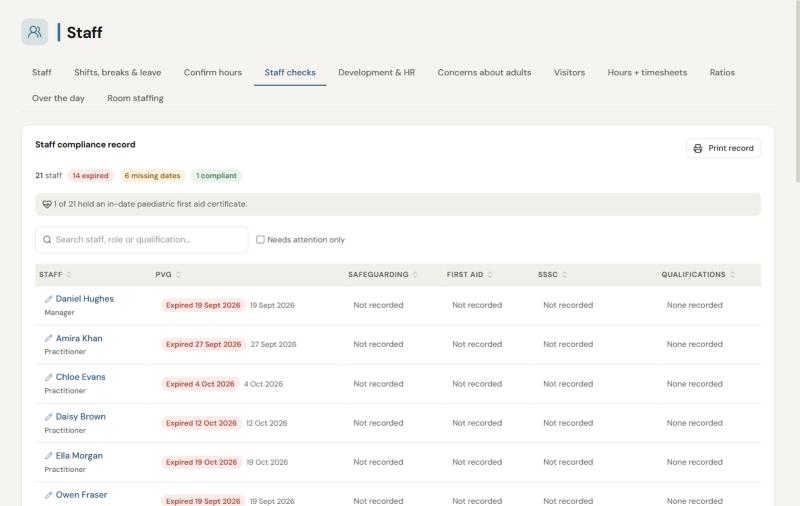
- Vetting. An enhanced check with the barred lists in England and Wales (through the DBS), membership of the PVG Scheme in Scotland, and an AccessNI check in Northern Ireland.
- What you record. For each check: what it was, its reference, the date it was issued and who in your setting checked it. Keep identity and qualification checks beside it.
- Training. Safeguarding, paediatric first aid, food hygiene and anything your policies require, each with its renewal date.
- Registration. In Scotland, staff in day care of children must register with the SSSC. Check what your nation requires.
- Suitability over time. Ask staff to tell you of anything that might affect their suitability to work with children, and record that you asked.
What to do: Keep one list of every member of staff with their vetting, training and registration dates. Look at it monthly for anything due in the next three months, and book renewals before they lapse.
7. Evaluate yourself honestly, all year
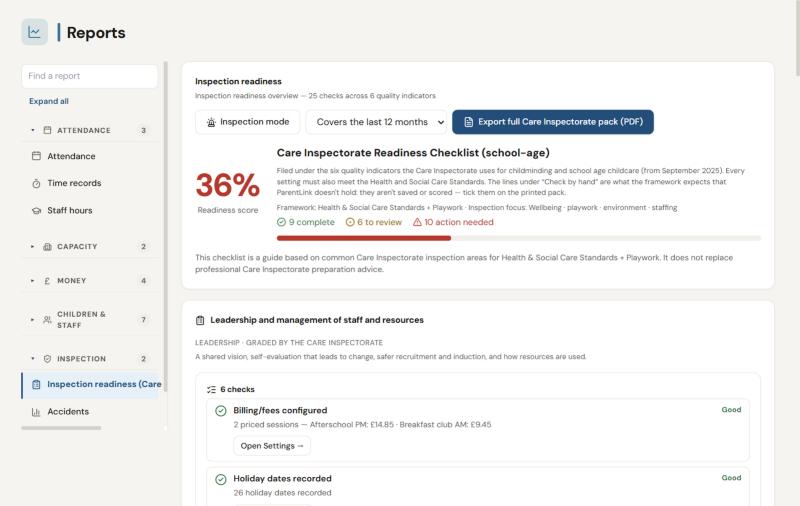
Self-evaluation is how you show an inspector that you know your setting: what is strong, what isn’t yet, and what you are doing about it. Each regulator expects it in its own way. In Wales, for example, the National Minimum Standards ask for a regular review of the quality of care. In Scotland, the Care Inspectorate expects settings to evaluate themselves against its quality framework. Check what your regulator asks for, and in what form.
Whatever the form, a useful self-evaluation:
- uses your regulator’s own headings, so it lines up with how you will be inspected;
- says what you have seen, not what you hope, with an example for each point;
- names your weaknesses as plainly as your strengths;
- shows what changed because of it, and when;
- includes the views of staff, parents and children.
An inspector who finds a problem you already knew about, and were already fixing, sees a setting that is well led. One who finds a problem you hadn’t noticed sees the opposite.
What to do: Review your self-evaluation each term, not just when an inspection is due. Add the date and what has changed since last time. Share the priorities with staff, so they can talk about them too.
8. Plan the day itself
The day goes better when nobody has to decide who does what while the inspector is in the hallway.
- Who greets. Decide who meets the inspector, checks their identity and signs them in. Decide who takes over if the manager is away, and make sure that person knows.
- Who is the main contact. Usually the manager. Name a deputy who can speak for the setting if the manager is with the inspector or off site.
- What to have ready. Your registration certificate, your self-evaluation, the day’s registers and rota, staff vetting and training records, policies, and the accident, medicine and safeguarding records. Know where each one is, on paper or on screen.
- Who covers. Staff time spent with the inspector can’t leave a room short. Plan cover before you need it.
- Keep the day normal. Don’t change the routine or move children around. Inspectors want to see what usually happens.
Tell parents an inspection is taking place, and that the inspector may want to speak to them. Many are glad to.
If the inspector raises something you think is wrong, say so calmly and offer the evidence. Note what was said and when.
What to do: Write the day on one page: who greets, who leads, who covers, and where each record is. Walk through it once a year with your deputy and room leads, as you would a fire drill.
9. After the visit
Most regulators give feedback at the end of the visit and send a draft report afterwards. Check your regulator’s process for how to raise a factual error, and by when.
Then:
- Thank your team and tell them what the inspector said, good and less good, the same day if you can.
- Read the draft carefully for factual errors, and raise any through your regulator’s process.
- Turn anything the report asks you to do into a plan, with an owner and a date for each point. Act on it before the report is published, not after.
- Tell parents about the report when it is published, and what you are doing about any actions.
- Fold it into your self-evaluation, so next year’s starts from where this one left off.
If you are unhappy with how the inspection was carried out, each regulator has a complaints process. Use it in writing, with dates and facts.
What to do: Book a team meeting within a week of the visit. Go through the feedback together, agree the three things that matter most, and put them in your self-evaluation with dates.