Most rotas are built the same way: last week’s copied forward, a few names swapped, and the gaps found at 07:40 when someone rings in sick. It works until the day it doesn’t: the room that drops under ratio over lunch, or the afternoon with no first aider on site.
A good rota answers three questions for every hour you are open. Are there enough adults for the children in each room? Is everyone getting their break without leaving a room short? And is the right person here — a paediatric first aider, your safeguarding lead, someone with the keys?
This guide covers:
- planning from the children who are booked, not from the staff you have;
- knowing which ratio rules apply to you;
- planning breaks into the rota;
- making sure every open day has its key people;
- usual patterns, day-by-day changes and publishing;
- covering a gap before it happens;
- checking the rota against what actually happened.
1. Start from the children, not the staff
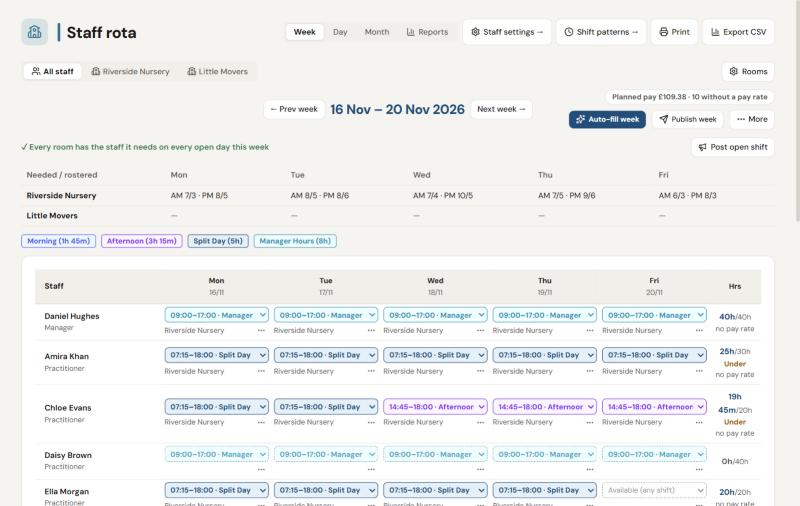
A rota that starts from staff hours ends up with the same people at the same times every day. But the number of children changes through the day and through the week: early drop-offs, a busy middle, a thin last hour. Mondays and Fridays often look nothing like Wednesdays.
Plan from your bookings. For each room, work out how many children are booked in each hour, and their ages. That tells you how many adults each room needs, hour by hour. The edges of the day matter most: opening, closing and lunch are where most settings run thin.
What to do: Take one typical week. For each room, list the children booked in each hour and the number of adults that needs. Build the rota to that shape, then check it against next week’s bookings before you publish.
2. Know which ratio rules apply to you
Ratios are set nation by nation, and they depend on the children’s ages and, in some cases, on the qualifications of the staff. Use the figures in your own framework, not a number a colleague remembers:
- England: the EYFS statutory framework sets the ratios and the qualification rules for each age group.
- Scotland: the Care Inspectorate’s guidance on staffing and ratios for day care of children.
- Wales: the National Minimum Standards for Regulated Childcare.
- Northern Ireland: the Minimum Standards for Childminding and Day Care for Children Under Age 12.
Be clear about who counts. Only staff working directly with children count towards ratios. A cook, an office manager or a cleaner does not, even if they are qualified, while they are doing that job. Students and apprentices count only where your framework says they can.
What to do: Write down, in one place, the ratio for each age group you care for and who on your team counts towards it. Check it each time your framework is updated.
3. Plan breaks into the rota, not around it
Breaks are where good rotas fail. Someone on their break isn’t working with children, so they don’t count towards ratios. Three people taking lunch at 12:00 can leave a room short for half an hour, even though the rota looked full.
Breaks are also a legal right. Across the UK, an adult who works more than six hours in a day is entitled to an uninterrupted rest break of at least 20 minutes. A worker under 18 is entitled to 30 minutes if they work more than four and a half hours. Your contracts may give more. Check them, and check with Acas or an employment adviser if you are unsure.
What to do: Give every shift over six hours a planned break, with a time. Stagger breaks so no room loses more than one adult at once, and name who covers lunch in each room. If breaks usually happen at the same time on the same shift, set them once on that shift and change them only on the days that differ.
4. Make sure every open day has its key people
Some roles have to be covered every day you are open, whoever else is in.
- Paediatric first aid. In England, the EYFS requires at least one person with a current paediatric first aid certificate to be on the premises and available at all times when children are present, and on every outing. The other nations set their own expectations. Check your framework and your regulator’s guidance.
- Safeguarding. Every setting needs a designated lead for safeguarding (in England the EYFS requires one). Staff need to know who to go to today, so plan who is the lead, or the deputy, on site each day.
- Opening and closing. Someone to open up, someone to lock up, and a key holder for the alarm.
These roles get missed because they sit on a person, not on a shift. The rota looks full, but the only first aider is on holiday.
What to do: List the roles you need every open day. For each day of the coming week, put a name against each role before you publish. When someone books leave, check whether they held a role that day.
5. Set usual patterns, then change the day
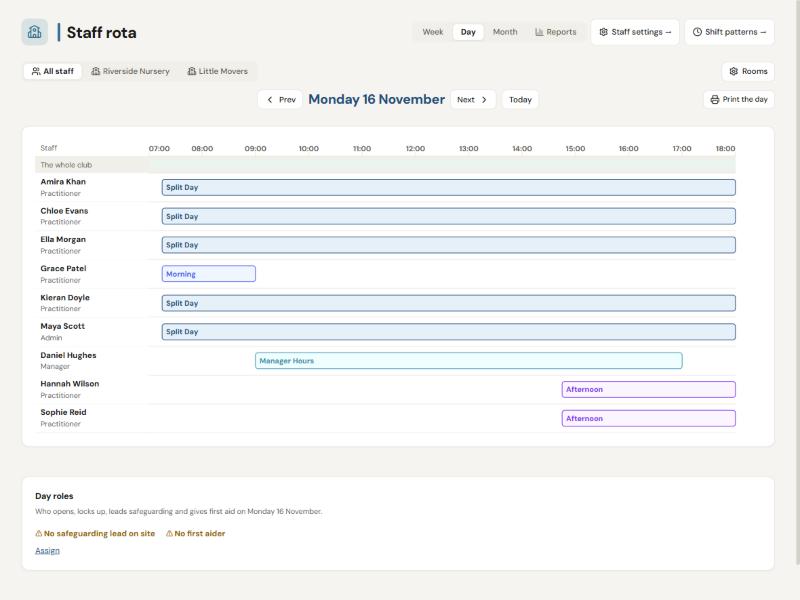
Most staff work a regular week. Set that up once — the shift, the room and their usual duties — and then change only the days that differ. A rota built this way takes minutes each week, not hours, and the exceptions stand out.
Publish the rota well ahead, so staff can plan their lives and swap shifts properly. Agree with your team how much notice they get, and keep to it. Check employment contracts for any notice they promise.
Make it easy to read. One sheet per day on the staffroom wall — who is in, when, where, and who is first aider or safeguarding lead today — is more use than a dense week grid nobody can read across the room.
What to do: Give every member of staff a usual pattern. Publish each week by the same day and print the day’s sheet each morning.
6. Plan for the gap before it happens
Someone will ring in sick. Decide now what happens next, so the person who takes the call isn’t making it up at 07:00.
- Keep a short list of who can be asked to cover, in order: part-time staff with spare hours, then bank or relief staff, then agency.
- Offer the shift to everyone qualified at once, rather than ringing round one by one.
- Know which room can lend an adult, and for how long, without going under ratio itself.
- If you can’t meet ratios, act on your policy: you may need to close a room, refuse late bookings, or ask parents to collect. Never let ratios slip “just for ten minutes”.
Record what you did and why. If an inspector asks about a difficult day, a clear record of how you kept children safe is what you need.
What to do: Write your sickness cover plan on one page, and make sure everyone who might take the call knows where it is.
7. Check the rota against what actually happened
A rota is a plan. The day is what happened: late arrivals, early finishes, a shift swapped by text. Ratios on the day are about who is actually in the room, not who was on the rota.
Inspectors in every nation can ask how you meet ratios. Your rotas, and your record of when staff signed in and out, are how you show it. A rota that no longer matches the day is a weak record.
What to do: Once a week, compare the rota with staff sign-in times. Look for patterns: the same room thin at the same time, the same break never taken, the shift that always runs late. Then change the plan, not just the day.