A parent hands over a bottle of antibiotics at the door, already late for work. A child with asthma sets off on a walk to the park. A new member of staff is asked to give a dose at 13:00 and can’t tell whether someone gave it at 12:30.
Medicines are one of the few parts of the day where a small slip can harm a child quickly. Most mistakes come from the same few gaps: permission that was never written down, a label nobody checked, an inhaler in a locked cupboard, a record kept in another room.
This guide is not medical advice. Follow the child’s doctor or pharmacist, the medicine’s label and your own regulator’s guidance. It covers:
- your medicines policy;
- written permission from parents;
- which medicines you will give;
- checking a medicine when it arrives;
- storing medicines, and keeping emergency ones close;
- recording every dose and telling parents;
- long-term conditions, health care plans and staff training;
- mistakes and near misses;
- returning medicine, and keeping the records.
1. Write a medicines policy your team can follow
Every setting that gives medicine needs a written policy, and staff who know it. In England, the EYFS statutory framework says you must have and follow a policy and procedures for giving medicines, including how you find out about a child’s needs for medicines and keep that information up to date.
The other nations have their own guidance:
- Scotland: the Care Inspectorate’s guidance on the management of medication in day care of children and childminding services.
- Wales: the National Minimum Standards for Regulated Childcare, which include medication.
- Northern Ireland: the Minimum Standards for Childminding and Day Care for Children Under Age 12, which include medication.
Your policy should answer the questions staff will actually face:
- which medicines you will and won’t give (see section 3);
- what permission you need from parents, and in what form;
- who may give medicine, and what training they need;
- how medicines are checked, stored and taken on outings;
- how doses are recorded, and when parents are told;
- what happens when a child has a long-term condition;
- what to do after a mistake or a near miss;
- how medicines go back to parents, or are disposed of.
What to do: Check your policy against your own framework’s current wording, not last year’s copy. Go through it at induction, including with bank and agency staff. Share it with parents when their child starts, and review it each year and after any mistake.
2. Get written permission for each medicine
In England, the EYFS says medicine, prescribed or not, must only be given to a child when you have written permission from their parent or carer for that particular medicine. The guidance in Scotland, Wales and Northern Ireland also expects consent in writing. Check the detail in yours.
“That particular medicine” matters. Permission for one medicine last term isn’t permission for an antibiotic today. A form signed at enrolment for “any medicine you think is needed” doesn’t name one.
A good permission form records:
- the child’s name and date of birth;
- the medicine’s name and strength;
- the dose, how it is given, and when;
- the start date and, if there is one, the end date;
- why it is needed;
- when the last dose was given at home;
- any storage instructions;
- the parent’s name, their signature and the date.
If the dose or the timing changes, the safe default is new written permission, not a phone call or a note in a bag.
What to do: Keep permission forms where medicines are handed over, and check each form is complete before the parent leaves. Tell every member of staff the rule plainly: no written permission, no medicine.
3. Decide which medicines you will give
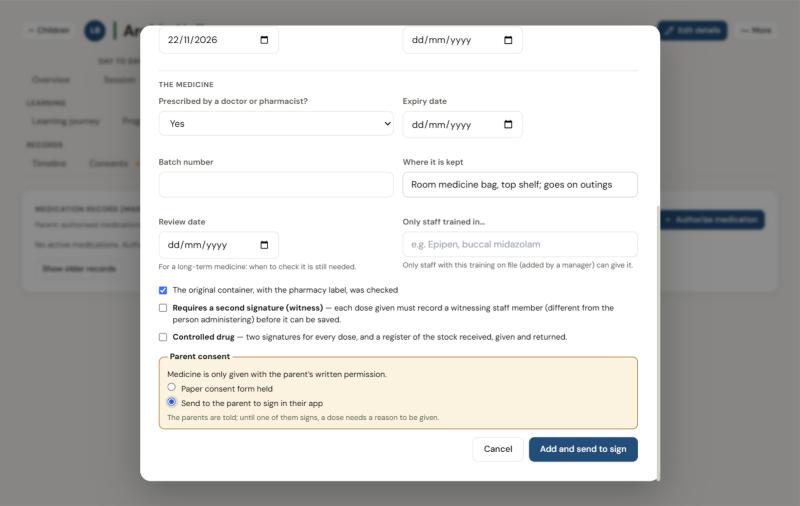
In England, the EYFS says prescription medicines must only be given when they have been prescribed for that child by a doctor, dentist, nurse or pharmacist, and that medicines containing aspirin should only be given if a doctor prescribed them. Check what your own framework says.
Non-prescribed medicines, such as pain relief or an antihistamine bought at a pharmacy, are where settings differ most. You set your own policy. Some settings don’t give them at all. Some give them only in limited cases, for example to a child who becomes unwell while waiting to be collected, with written permission for that medicine given in advance and a phone call to the parent before each dose. Check your framework, your regulator’s guidance and your insurer before you decide.
A few rules most settings write down too:
- A child’s medicine is only for that child. Never give it to another, even a brother or sister.
- A new medicine starts at home. Many settings ask parents to give the first dose of a new medicine at home, so any reaction happens with them.
- Medicine isn’t a way to keep an unwell child at the setting. Your illness and exclusion policy decides when a child should be at home.
What to do: Write down what you will give, what you won’t, and the conditions for each. Put it on your permission form, so parents know before they ask.
4. Check every medicine when it arrives
Most mistakes can be stopped at the door. Check the medicine with the parent there, before they leave:
- It is in its original container, as it came from the pharmacy or shop, with the leaflet. Don’t accept medicine poured into another bottle.
- A prescribed medicine has a pharmacy label with this child’s name. Not a brother’s or sister’s.
- The dose and timing on the label match the permission form. If they don’t, ask the parent to check with the pharmacist or doctor, and don’t give it until it’s cleared up.
- It is in date. Check the expiry date, and any “use within” date once it has been opened.
- You know how to store it. In the fridge or at room temperature, as the label says.
- Anything needed to give it is there, such as an oral syringe, or a spacer for an inhaler.
Record who checked it, and when. If anything is wrong, the medicine goes home with the parent.
What to do: Make the check part of every handover, even for a child who has had the same inhaler for a year. A label can change when a prescription does.
5. Store medicines safely, and keep emergency ones close
Medicines must be out of children’s reach, and still quick to find for the staff who need them.
- Keep each medicine in its original container, labelled, in a locked cupboard or box out of children’s reach, unless it is an emergency medicine.
- Follow the label on temperature. A medicine that needs a fridge goes in a fridge children can’t get to, in a sealed, labelled box, away from food.
- Keep emergency medicines where they can be reached at once. A reliever inhaler or an adrenaline auto-injector should never be behind a lock nobody can find the key to. Every member of staff in the room should know where it is.
- Emergency medicines go where the child goes: the garden, another room, the school run and every outing, in a labelled bag with a copy of the child’s plan.
- Ask the pharmacist about controlled drugs. Some medicines are controlled drugs, with stricter rules on how they are stored and recorded.
Check expiry dates regularly. An emergency medicine past its date is one you can’t rely on. Tell the parent well before it runs out, so the replacement arrives first.
What to do: Walk round your setting and find every medicine. Is each one locked away, or within reach in an emergency? Add medicines to your outing checklist, and check every expiry date once a month.
6. Record every dose, and tell parents the same day
In England, the EYFS says you must keep a written record each time a medicine is given to a child, and tell the child’s parents or carers the same day, or as soon as reasonably practicable. The other nations’ guidance also expects a record of medicines given. Check what yours asks you to record.
Before giving a dose, check the record:
- when the last dose was given, here or at home;
- how many have been given today, against the most allowed;
- how long it has been since the last one.
This is how a dose gets given twice: one person gives it at 12:30 and writes it down at 14:00, and someone else gives it at 13:00.
Then check the child, the medicine, the dose, the time and how it is given, against the form and the label. Give it, and record it straight away:
- the date and the time;
- the medicine and the dose given;
- who gave it;
- who witnessed it, if your policy asks for a second member of staff. Some settings ask for a witness for every dose, others only for some medicines;
- anything you noticed.
Record a dose that was refused, spat out or missed too, and tell the parent. Don’t rewrite a record later. If something was wrong, add a dated note underneath.
When the parent collects, tell them what was given and when. Many settings ask them to sign the day’s record too.
What to do: Keep the record with the medicine, not in the office, so it is checked before every dose. Once a week, have a manager read the records against the permission forms: the right doses, at the right times, with parents told.
7. Plan for long-term conditions, and train staff
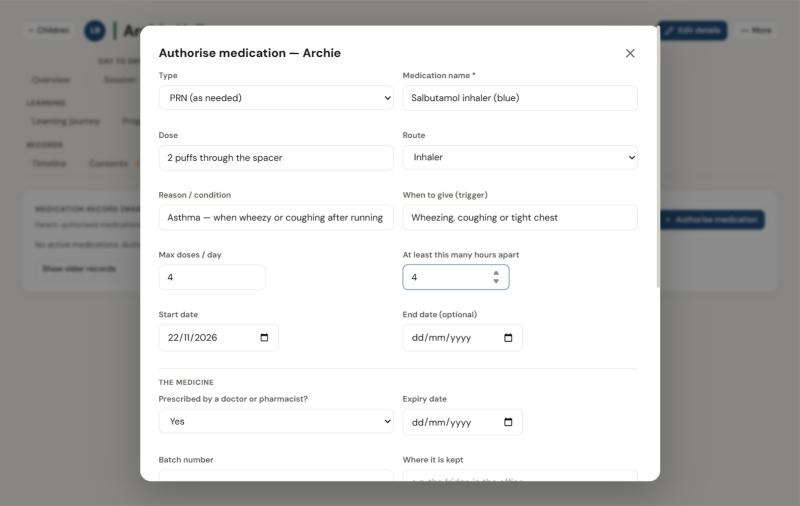
A child with asthma, epilepsy, diabetes or a severe allergy needs more than a permission form. They should have an individual health care plan, written with their parents and, where they have them, the health professionals who look after them.
A good plan says:
- what the condition is, and how it shows in this child;
- their daily care, and the medicines they take, with the doses and where they are kept;
- the signs of an emergency, and exactly what to do;
- who to call, and in what order;
- what staff need to be trained in;
- when the plan will be reviewed.
In Scotland, the plan sits alongside the child’s personal plan. Review it at the date you agreed, and whenever anything changes. Ask parents to tell you straight away when a dose, a medicine or a diagnosis changes.
Some medicines need training. In England, the EYFS says training must be provided for staff where giving a medicine needs medical or technical knowledge. That covers medicines such as adrenaline auto-injectors, rescue medicine for seizures, insulin, and anything given through a tube. Get the training from a qualified health professional, keep a record of who was trained and when, and plan refreshers. Paediatric first aid on its own doesn’t cover a particular child’s plan.
What to do: List every child with a long-term condition. Check each has a current plan, agreed with the parents, with a review date, and that someone trained to give their medicine is on the rota for every session they attend.
8. Handle mistakes and near misses openly
Mistakes happen in good settings: the wrong child, the wrong dose, a dose given twice, a dose missed, a medicine given past its date or without permission. What matters is what you do next, and whether it happens again.
When a mistake happens:
- Look after the child first. Watch them closely. Get medical advice straight away, with the medicine and its packaging to hand. Call 999 if the child is seriously unwell. For urgent advice, call NHS 111 in England and Wales, or NHS 24 on 111 in Scotland. In Northern Ireland, contact the child’s GP or the out-of-hours service.
- Tell the parent straight away, honestly: what happened, what you have done, and the advice you were given.
- Tell your manager, who decides what else needs to happen.
- Record it the same day: what happened, when, who was involved, what was done and the advice given.
- Check whether your regulator needs to know. In England, the EYFS says you must notify Ofsted of any serious illness or injury to a child in your care. The Care Inspectorate, Care Inspectorate Wales (CIW) and your HSC Trust early years team each set out what they expect to be told, and when. Check their current guidance. Don’t assume England’s rules apply.
If one child was given another child’s medicine, don’t share either child’s name or health details with the other family.
Record near misses too: the dose caught before it was given, the wrong bottle picked up and put back. They show you where the next mistake will happen.
Then ask why, not who. Was the record in another room? Are there two children with similar names? Was someone interrupted halfway through a dose? Change the system and retrain, so the same slip can’t happen the same way.
What to do: Write these steps into your policy and put them up where medicines are given. After every mistake or near miss, hold a short review, record what you changed, and check a month later that it worked.
9. Send medicine home, and keep the records
Medicine shouldn’t sit in your cupboard after it is needed. Return it to the parent when the course ends, when it goes out of date, or when the child leaves. Record what was returned, to whom and when.
Don’t put medicines in the bin or down the sink. If a parent can’t take a medicine back, ask a pharmacy how to dispose of it. Ask them about needles and used auto-injectors too.
Medicine records and health care plans are personal data. Details of a child’s health are special category data under UK GDPR. Keep them secure, and share them only with staff who need them.
How long to keep them is your decision, set in your retention policy. Don’t clear them out early. Questions about a dose given to a child can come years later. Ask your insurer what they expect, and write the reason beside the period.
What to do: Once a month, find the medicines that have finished or are near their date, and send them home. Put your retention period for medicine records in your policy, with the reason.