A new child starts on Monday. The form says “nuts”. Nobody knows whether that means peanuts, tree nuts or both, whether it is an allergy or a dislike, or what to do if the child eats one. By Wednesday the cook has changed the bread supplier.
Most allergy mistakes in childcare aren’t about not caring. They happen in the gaps: between the form and the kitchen, between the cook and the room, between the usual staff and the agency worker covering lunch.
This guide covers:
- getting the full picture at registration, and keeping it current;
- writing an allergy plan with the family;
- making sure every adult who serves food knows, today;
- knowing what is in every dish, including the 14 allergens;
- snacks, birthdays and food from home;
- outings, new staff and agency staff;
- recognising a reaction and following the plan;
- learning from near misses.
1. Get the full picture at registration
A one-word answer on a form is the start of a conversation, not the end of one. Ask every family, not only the ones who tick Yes.
Sort what you are told into kinds, because each needs a different response:
- Allergy. The body’s immune system reacts to a food. A reaction can be mild, or sudden and life-threatening (anaphylaxis). Even a trace can matter.
- Intolerance. The body finds a food hard to digest, such as lactose in milk. It can make a child unwell, but it is not the same as an allergy. Ask what happens, and how much is too much.
- Medical diet. A diet a health professional has set, such as gluten-free for coeliac disease, a diet for diabetes, or softer textures for a child who finds swallowing hard. Follow it exactly as written.
- Religious and cultural diets. Halal, kosher, no pork, no beef, vegetarian. Ask what it means for this family, such as whether gelatine, or food cooked alongside meat, is acceptable. Don’t assume.
- Preferences. A family’s choice, such as vegan, or a food a child won’t eat. Respect them and record them, but keep them apart from allergies, so the list that matters stays clear.
For an allergy or a medical diet, ask for the detail: which food, exactly; what happens, and how quickly; whether a doctor diagnosed it; whether medicine is prescribed; and whether “may contain” labels matter for this child.
In England, the EYFS statutory framework says that before a child is admitted, providers must obtain information about any special dietary requirements, preferences and food allergies the child has, and any special health requirements. The standards in Scotland, Wales and Northern Ireland also expect you to know and meet each child’s dietary and health needs. Check the wording in yours: the Health and Social Care Standards in Scotland, the National Minimum Standards for Regulated Childcare in Wales, and the Minimum Standards for Childminding and Day Care for Children Under Age 12 in Northern Ireland.
Allergies change. Children outgrow some and develop others. Ask families to tell you the same day anything changes, and don’t rely on them remembering.
What to do: Read your registration form as a new parent would. Does it separate allergy, intolerance, medical diet, religious or cultural diet and preference? Does it ask what happens and what to do? Then check every child’s details with their family at least once a year, and after any reaction, new diagnosis or new medicine.
2. Write an allergy plan with the family
For every allergy, and every medical diet, write a plan with the parents. Where the child has a diagnosis, base it on what their doctor, allergy nurse or dietitian has said. Many families are given a written allergy action plan by the child’s doctor. Ask for a copy and use it.
A good plan has:
- the food, exactly, and the other names it goes by on labels;
- how severe the allergy is;
- the signs of a reaction, from mild to serious;
- what to do, step by step;
- the emergency medicine, as prescribed, where it is kept and when it expires;
- who to call, in what order;
- the date, and who agreed it.
Follow your medicines policy for the child’s medicine. In England, the EYFS requires written permission from a parent before staff give any medicine. The other nations’ standards set their own expectations. Check yours.
For a child with complex needs, ask the family whether their health visitor, school nurse or specialist can help write or check the plan, and show staff what to do.
A plan in the office protects nobody. Every member of staff who looks after the child needs to have read it, including the cook.
What to do: For every child with an allergy or a medical diet, check you have a written plan, agreed with a parent and dated. Review each one at least once a year, after any reaction and whenever anything changes. If a plan is missing the medicine’s expiry date, ask the family for it this week.
3. Make sure every adult who serves food knows, today
What matters at 11:45 is that the person holding the serving spoon knows which children are in today, and what each of them can’t have.
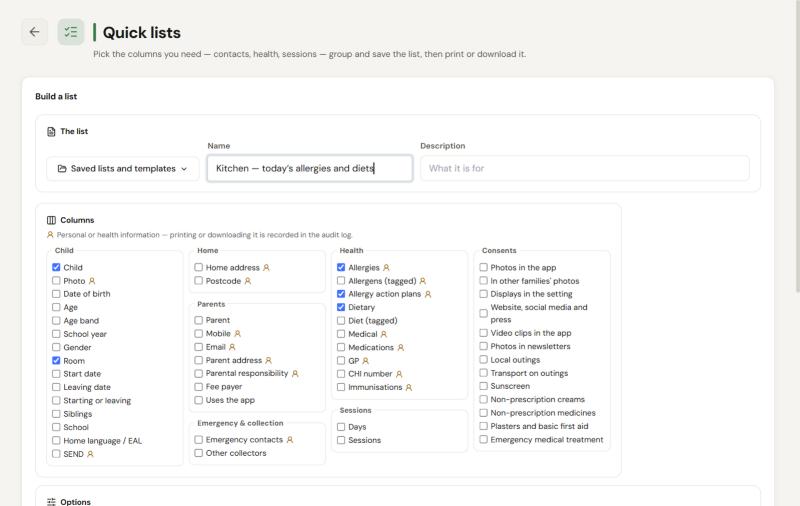
- A list in the kitchen and in every room. The children in today with an allergy or a diet, most severe first. Print it each morning, so it matches who is actually in, not who was in last week.
- Keep it private. Put the list where staff can see it and visitors and other parents can’t. Health details are special category data under UK GDPR. If your list has photos, follow your photo consents and keep it out of public view.
- Know the child at the table. Many settings do it without photos: a named place card, plate or placemat, and the adult reading the name aloud before the plate goes down.
- Seat children with care. Sit a child with a severe allergy where an adult can see them throughout the meal, away from food being passed or shared, but with their friends, not on their own.
- Serve and check. Serve their plate first, with its own utensils. One named adult checks it against the list before it goes down. For a severe allergy, a second adult checks too.
- Keep it apart in the kitchen. Separate boards, utensils and serving spoons. Prepare allergy meals first, or apart, then cover and label them.
- Clean before and after. Wipe tables before and after eating. Wash hands with soap and water, children’s and adults’. The Food Standards Agency says hand gel doesn’t remove allergens.
What to do: Print a fresh list each morning for the kitchen and every room. Name the adult who checks plates at each meal, in each room, and make the second check for severe allergies a rule, not a habit.
4. Know what is in every dish
UK food law requires food businesses to provide information about 14 allergens when they are used as ingredients. The Food Standards Agency (and Food Standards Scotland in Scotland) publishes guidance on what this means. If your setting provides food, you must be able to tell parents which of the 14 are in each dish you serve.
The 14 are:
- celery;
- cereals containing gluten, such as wheat, rye, barley and oats;
- crustaceans, such as prawns and crab;
- eggs;
- fish;
- lupin;
- milk;
- molluscs, such as mussels and squid;
- mustard;
- tree nuts, such as almonds, hazelnuts and walnuts;
- peanuts;
- sesame;
- soya;
- sulphur dioxide and sulphites.
A child can be allergic to something outside the 14, such as kiwi or a particular fruit. Your allergen record won’t catch it. Check those by hand, every time.
Every change of recipe, brand or supplier is a change to the allergens. Manufacturers change their recipes too. Read the label each time a product arrives, not only the first time. Decide with each family whether “may contain” matters for their child, and write it in the plan.
A setting that provides food may also need to register with its local authority as a food business. Check with your local authority’s environmental health team.
What to do: Keep an allergen record for every dish on your menu, built from the labels of what you actually buy. Make it a rule that nobody swaps an ingredient, brand or supplier without updating the record and telling whoever checks plates. Share the week’s menu with families, with the allergens shown.
5. Plan for snacks, birthdays and food from home
Food that doesn’t come from your kitchen is where good systems break. A cake in a tin, a packed lunch shared at the table, a box of biscuits from a grateful parent.
- Snacks. Treat them as meals: the same allergen record, the same plate check.
- Birthdays and celebrations. Decide your rule and tell families at registration. Some settings ask families not to bring food in. Some celebrate without food. Some accept only shop-bought food in its packaging, with the ingredients list. Whatever you choose, check it against every allergy in the room before it is served.
- Packed lunches. Label each with the child’s name, and make “no swapping” the rule. If a severe allergy means you ask other families not to send a food, say so without naming the child.
- Play and craft. Pasta, flour, play dough, egg boxes, cereal boxes and bird feeders can all carry allergens. They count too.
- Treats from staff. Rewards and treats go through the same checks as everything else.
What to do: Write a short policy on food from home and celebrations, and give it to every family when they register. Add play and craft materials to your allergen checks.
6. Plan for outings, new staff and agency staff
The risk rises when the routine changes.
Outings. The child’s emergency medicine and a copy of their plan go with them, carried by an adult who stays with the child and knows how to use it. Check before you leave, not at the gate. Take food you prepared, or check the labels of anything you buy. Know the address of where you will be, and how you will call for help.
New, bank and agency staff. Before they help with any meal, show them who is in today with an allergy or a diet, what each child can’t have, and where the medicines are kept. Someone who hasn’t been shown doesn’t serve a child with a severe allergy.
Room moves and cover. When a child moves room, or staff cover another room for lunch, the plan and the medicine move with the child, and the new adults are told.
What to do: Add allergies to your outing checklist and your induction checklist. Give every cover worker a one-page handover of who is in today and what they can’t have, before their first meal.
7. Recognise a reaction, and follow the plan
This section is not medical advice. Follow each child’s plan, your paediatric first aid training and the NHS’s guidance on allergies and anaphylaxis.
- Know the signs. Every member of staff should know, from their training and the child’s plan, the early signs of a reaction and the serious ones. A reaction can start within minutes, or later.
- Follow the plan. If the plan says to give the emergency medicine, give it. Don’t wait to reach the parent first.
- Call 999 for anaphylaxis. The NHS says to call 999 and say you think it is anaphylaxis. Any member of staff can call. They should not wait to find the manager first.
- Then phone the parent, and record the time of each step: the first signs, the medicine, the call.
- Tell the parent the same day about any reaction, however mild, and record it.
Adrenaline auto-injectors belong with the child, not in a locked office. Keep them where they can be reached quickly, and take them between rooms, into the garden and on every outing. Check each one’s expiry date every month, and ask the family for a replacement in good time. Make sure staff are trained to use the child’s own device, because they don’t all work the same way.
A serious reaction may also need reporting to your regulator. Check its notification guidance.
What to do: Practise an allergy emergency with your team, as you would a fire drill: who gives the medicine, who calls 999, who phones the parent, and who looks after the other children. Check every auto-injector’s expiry date on the same day each month.
8. Record and learn from near misses
A near miss is a warning you got for free. The wrong plate stopped at the table. A cake with nuts spotted before it was cut. A recipe that changed without anyone knowing.
Record each one as an incident, the same day: what happened, what stopped it, and what could have happened. Do it without blame. If staff are blamed for reporting near misses, they stop reporting them.
Read them together. Look for the same meal, the same room, the same time of day, the same supplier, or a new member of staff on duty. A pattern tells you which part of the system to fix.
What to do: Tell your team plainly that a near miss reported is a good thing. Once a month, have a manager read every allergy near miss and reaction together, and change at least one thing as a result.