Unpaid fees are one of the hardest parts of running a setting. You care for the child every day, you know the family, and the balance keeps growing while nobody mentions it. By the time someone does, it can feel too big to sort out kindly.
Most arrears start small: a missed payment after a change of job, a Direct Debit that failed, a bill the family didn’t understand. Raised early, in private and in writing, most are put right without losing the family. Left late, they can end in a lost place and a debt you may never recover.
This guide covers:
- terms that make arrears less likely;
- bills that are easy to understand and easy to pay;
- spotting arrears early;
- the first conversation;
- payment plans in writing;
- pointing families to help;
- where funded hours stand;
- an escalation path you follow every time;
- the last steps, if nothing else works.
1. Prevent it in your terms, before a child starts
Most fee disputes come back to something the contract didn’t say, or said in a way nobody read. Your terms are the place to decide, calmly and in advance, how fees work and what happens when they aren’t paid.
Your terms and conditions should set out:
- what you charge, and what is included;
- what is extra, and which extras are optional;
- when you send bills, when payment is due and how families can pay;
- any deposit: what it is for, and when it is refunded or kept;
- who is responsible for paying. If two adults sign, say whether each is responsible for the whole amount;
- the notice a family must give to leave, and the notice you will give;
- the steps you take if fees go unpaid, in order (see section 8).
Keep any late payment charge fair. The Consumer Rights Act 2015 says the terms of a contract with a consumer must be fair and written in plain language. A charge far above what late payment actually costs you may be unfair, and an unfair term is not binding on the family. The Competition and Markets Authority publishes guidance on unfair terms.
If a child will take only funded hours, check your local authority’s provider agreement before you ask for a deposit or any other charge (see section 7).
Have a solicitor read your terms once, and again when you change them. Ask every family to sign before their child starts, and give them a copy.
What to do: Read your terms as a parent would. If you can’t find, in one place, when fees are due and what happens if they aren’t paid, rewrite that part before your next new starter.
2. Make the bill easy to understand and easy to pay
A family who doesn’t understand a bill often doesn’t pay it. They mean to ask, then don’t. And a family who has to remember to pay is more likely to be late than one whose payment goes by itself.
- Direct Debit. It is collected on the date you set, so nobody has to remember. Families are protected by the Direct Debit Guarantee and can cancel through their bank at any time, so a cancelled mandate is worth noticing.
- One payment date. Pick a date, put it in your terms and keep to it. Ask new families whether it suits them before they sign.
- Bills that explain themselves. Show the sessions and their prices, any funded hours taken off, extras, discounts, what has been paid and what is left. Put the due date where nobody can miss it.
- Tax-Free Childcare. If you accept it, make sure families know how to pay you through it and which reference to use.
- A named person for questions. Tell families who to ask about a bill, and answer quickly.
What to do: Take last month’s bill for one family and read it cold. Could a parent tell what they were charged for, what the funded hours took off and when to pay? If not, change the bill, not the family.
3. Spot arrears early
Care carries on every week, so arrears grow every week. One month’s fees are a conversation. Several months’ fees are a problem for the family and for you.
Watch for the early signs:
- a missed or part payment;
- a failed Direct Debit, or a cancelled mandate;
- a family who always paid on time and now pays late;
- questions about the bill that didn’t come before;
- a parent who starts avoiding the office at pick-up.
Give one person the job of checking who owes what, every week. Arrears get missed when everyone assumes someone else has seen them.
What to do: Set a day each week to check balances. Decide how soon after a missed payment you will contact the family, write it in your procedure, and keep to it for everyone.
4. Have the first conversation early, and in private
The first conversation sets the tone. Keep it private, kind and specific.
- Private. Not at the door, not in front of the child, and not where staff or other parents can hear. Ask for a few minutes in the office, or call.
- Kind. Assume nothing. Most families who fall behind are embarrassed, not dishonest. Ask whether everything is all right before you ask for money.
- Specific. Say the amount, the weeks or months it covers and when it was due. A vague worry is harder to answer than a clear figure.
For example: “We noticed October’s payment hasn’t come through. Is everything all right? We’d like to find a way to sort it together.”
Talk to the person responsible for the fees under your contract. A family’s arrears are personal data under UK GDPR. Share them only with the staff who need to know. Don’t raise them with anyone else who collects the child, or with the other parent, unless they are also responsible under the contract or the parent has agreed. Separated parents can both have parental responsibility, but that doesn’t by itself give one a right to see the other’s account.
After the conversation, send a short note of what you agreed. It helps you both.
What to do: Write a few lines of wording for the first conversation and the follow-up note, so whoever has the conversation doesn’t have to invent it. Keep a dated note of every conversation on the family’s account, not in a staff chat.
5. Agree a payment plan, and put it in writing
If the family can’t clear the balance at once, agree a plan. A realistic plan that is kept is worth more than a demanding one that fails in a month.
A written plan says:
- the balance owed today;
- how much will be paid towards it, and when;
- that current fees are still paid as normal;
- how the family will pay;
- what happens if a payment is missed;
- when you will review it together.
Decide whether late payment charges stop while the plan is kept, and say so. Send the plan by email or letter and ask the family to confirm they agree.
Be consistent. Families talk, and a plan offered to one family and refused to another is hard to defend. Base each plan on what the family can pay, and record why you agreed it.
What to do: Keep a short payment plan template ready. When a payment in a plan is missed, contact the family as quickly as you would for any missed payment, and talk before you move to the next step.
6. Point families to help they may be missing
Some families fall behind while missing help they could claim. You can’t advise them on what they are entitled to, but you can point them to where to look.
- Tax-Free Childcare. A UK-wide government scheme that adds to what eligible working families pay into an online childcare account.
- Universal Credit childcare costs. Working families on Universal Credit may be able to claim back part of the childcare they have paid for. They need proof of what they paid, so send statements promptly when asked.
- Funded hours. A family may be eligible for funded hours they haven’t claimed, or may have let their eligibility lapse. Each nation and local authority runs its own schemes.
- Local authority support. Your local authority, or its family information service, can tell families what other help is available in your area.
- Free debt advice. Citizens Advice (Citizens Advice Scotland in Scotland, Advice NI in Northern Ireland) and MoneyHelper offer free, confidential help with money and debt.
The government’s Childcare Choices website explains the main schemes and who can get them.
What to do: Keep a short list of these, with links, to give any family who is struggling. Give it to every new family too, so asking for help doesn’t have to start with admitting a debt.
7. Know where funded hours stand
Funded hours are paid for by the local authority, not the family, under the agreement you signed to offer them. That agreement limits what you can do when other fees go unpaid.
In general, funded hours are meant to be free to the family. Provider agreements commonly say you can’t make a child’s funded place depend on paying for additional hours, meals or other extras, and that charges for extras must be clear and separate. So you generally can’t withhold or suspend the funded entitlement because extras or additional hours are unpaid.
Hours a family pays for above the funded entitlement are covered by your own terms. Even so, the detail differs between England, Scotland, Wales and Northern Ireland, and between local authorities. Check your local authority’s provider agreement, and ask its early years team before you act on a funded child’s place.
Make your bills show the funded hours separately, so it is clear the balance owed is for something else.
What to do: Read the parts of your provider agreement on charges and on ending a place before you write the fee terms for funded children. If in doubt, ask your local authority in writing and keep the reply.
8. Follow an escalation path, the same for everyone
Families should never be surprised by what happens next. The steps are in your terms. Follow them in order, at the times you set, for every family.
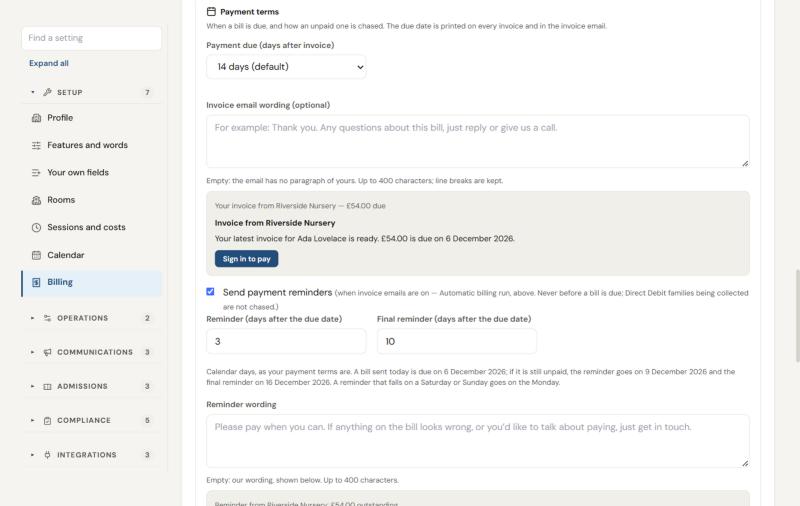
- A reminder soon after the due date, friendly and short.
- A final reminder, and a call or a meeting.
- A final letter: the amount, the date by which it must be paid or a plan agreed, and what happens if it isn’t.
- Suspending paid-for hours, as a last resort, only if your terms allow it and with the notice they give.
- Ending the place, with the notice in your contract.
Before you suspend or end a place, think about the child. A sudden end to their care can be hard on them, and money trouble is sometimes a sign of wider difficulty at home. Talk to your designated safeguarding lead first. If the child has a social worker, or is a looked-after child, talk to the social worker before the place ends.
However far it goes, some lines don’t move. Never keep a child back at collection over money, never mention fees to the child, and never treat a child differently because of what their family owes.
Record each step: the date, what was sent or said, and the reply.
What to do: Write your escalation path on one page, with the timings, and check it matches your terms. Make one person, usually the owner or manager, responsible for deciding each step after the final reminder.
9. If it still isn’t paid: the last steps
Sometimes the plan fails, or the family leaves owing. Decide whether to pursue the debt. The time, cost and stress of chasing it may be more than the amount, and writing off a small debt can be the right choice. Record the decision either way.
If you do pursue it, the usual routes are:
- A formal letter first. In England and Wales, a business claiming a debt from an individual is expected to follow the Pre-Action Protocol for Debt Claims before going to court. That includes a letter setting out the debt, with an information sheet and a reply form, and time for the family to respond.
- England and Wales: the small claims track in the county court, which you can start online.
- Scotland: the simple procedure in the sheriff court.
- Northern Ireland: the small claims court, part of the county court.
- A debt recovery agency or a solicitor. Choose one that treats people fairly. How it behaves reflects on your setting.
Each court route has its own limits, fees and steps. Check the official guidance for your nation before you start: GOV.UK for England and Wales, the Scottish Courts and Tribunals Service, or the Northern Ireland Courts and Tribunals Service. A decision in your favour doesn’t guarantee payment. Getting the money is a further step.
Your privacy notice should tell families that you may share their details with a solicitor, a debt recovery agency or a court to recover unpaid fees. Share only what is needed.
This is not legal advice. For your own position, speak to a solicitor. Families can get free advice from Citizens Advice.
What to do: Before you start any claim, gather your records: the signed terms, the bills, the reminders, the final letter and your notes of every conversation. If any are missing, take advice before you go further.