An empty place costs you every week it stays empty, and that income doesn’t come back. But most settings don’t have empty places across the whole week. They have a quiet Monday, a thin Friday afternoon, a baby room with space and a pre-school room with none, or a September when the school starters have gone and the new children haven’t started.
Filling places starts with knowing exactly where the gaps are. Then it is a matter of reaching the families who need those sessions, answering them quickly, and offering what you actually have.
This guide covers:
- measuring occupancy by session, at your busiest time;
- finding where your gaps are;
- keeping your waiting list current;
- answering enquiries fast, and visits that help families decide;
- offering the sessions you have;
- how funded hours shape demand;
- being found locally, and recommended by your families;
- planning for leavers months ahead;
- tracking what works.
1. Measure occupancy by session, not as an average
The usual figure is one percentage: children on roll against places, or hours booked against hours open. It looks reassuring, and it hides the shape of your week.
Take a room with 24 places. If it is full from Tuesday to Thursday and has 12 children on Mondays and Fridays, its figure for the week looks healthy. But you can’t offer a place to a child who needs every day, and you have 12 free places on two days that a single figure never shows you.
Counting children on roll is worse. A room of part-timers can have more children on roll than places, and still have empty sessions.
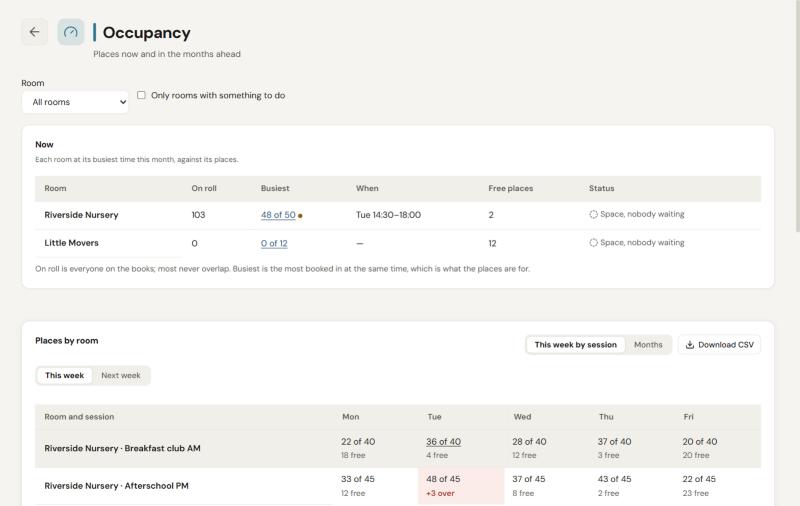
Count instead the most children in at the same time, session by session:
- Write down each room’s places: the most children it may have at one time. Your registration, your space and your ratios set this. Check your registration conditions.
- Split the week into the sessions you sell, such as Monday morning and Monday afternoon, or your own session times.
- For each session, count the children booked in at the same time. A child booked until 13:00 takes a place in an afternoon that starts at 12:30. Two children whose times never overlap can share one place.
- Write each one as a count of places: “18 of 24”, not a percentage. It tells everyone exactly how many places are free.
- Find each room’s busiest session. That is the figure that decides whether you can take a child who needs every day.
Count bookings, not attendance. A child on holiday still has their place. And count the months ahead too, not just this week: who is leaving, who is starting, and who is moving up to the next room.
What to do: This week, draw a grid for each room, with the days across and the sessions down. Fill in the children booked in each session and the places free. Update it each time a booking changes, or at least once a month.
2. Find where your gaps are
With the grid in front of you, the gaps usually fall into a few patterns:
- Mornings and afternoons. Mornings often fill before afternoons. Families who want short days leave the end of the day quiet.
- Days of the week. Mondays and Fridays are often quieter than midweek, as many families who work part-time choose the middle of the week.
- Age groups. One room can be full with a waiting list while the next has space. A full room can also cause a gap: if the toddler room is full, babies can’t move up, and the baby room can’t take new starters.
- The time of year. Children who leave for school usually go in the summer, so the new school year can open with gaps in your oldest rooms. Families also tend to look for childcare at set times: before a return to work, or before their funded hours begin.
For each gap, ask why. Is it demand, because few families near you want Friday afternoons? Price, because a half day costs almost as much as a full one? Or a rule of your own, such as a minimum of three days? The answer decides what to do.
What to do: List your gaps in order of size, with a reason beside each one. Choose the two or three that matter most, and work on those first.
3. Keep your waiting list current, and contact families quickly
A waiting list fills a place only if the families on it still want one, and you reach them before someone else does. A long list of names from last year is not a plan.
Keep three things true for every family: that they are still looking, which days and sessions they need, and from when. Check in with families who have been waiting a while, and take off those who have found somewhere else. There is a separate guide in this Academy on managing a waiting list, with the detail on priority rules, offers and data protection.
When a place comes up, move quickly. Look at the list the same day, contact the family who fits best, and give them a clear offer with a date to reply by. If the free place is on Mondays and Fridays, ask the families who wanted those days, not only the family at the top.
And look further ahead. If you know a place is coming in March, offer it in January, while a family can still plan around it.
What to do: Each week, check the waiting list against your grid of free sessions. For every gap, name the families who could fill it, and contact them.
4. Answer enquiries fast, and make the visit count
Families often enquire with several settings at once. The setting that answers first, and clearly, has a head start.
A good first reply:
- answers the question they asked: whether you have their days, from when, and roughly what it costs;
- says plainly what you can offer if you don’t have their days;
- explains how funded hours work at your setting, if they may be eligible;
- offers a visit, with times to choose from.
Decide who answers enquiries, and how quickly. Enquiries that arrive by phone, email, your website and social media need one place to land, so none is missed while the manager is on leave.
The visit is where families decide. Make it about their child, not a tour of the building:
- show the room their child would be in, at a time when children are there, and introduce the staff they would meet;
- explain how settling in works, and what their child’s first weeks would look like;
- make sure whoever shows them round knows which sessions are free, the prices and how to secure a place;
- give them something to take away: your sessions, your prices, what is included, and the next step.
Follow up within a day or two with a thank-you and the next step. If you have a place for them, make the offer in writing, with a date to reply by.
What to do: Set a standard, such as every enquiry answered by the end of the next working day, and check it each week. Write a one-page visit plan, so every visit covers the same ground, whoever gives it.
5. Offer the sessions you actually have
A family asking for five full days is hard to place if your gaps are on Mondays and Fridays. A family who wants Mondays and Fridays is easy. Lead with what you have.
- Say which sessions are free. On your website, in your enquiry replies and on social media: “We have places on Monday and Friday mornings in our toddler room.” Families who need those days will come forward.
- Look again at your booking rules. A minimum number of days, or full days only, may have made sense once. If it now turns away families who would fill your gaps, change it. Think about settling in, continuity for young children and staffing before you do.
- Offer part days where you can staff them. A morning, an afternoon or school hours can fill a gap a full day can’t. Price it so it works for you as well as the family.
- Offer extra days to the families you already have. They know you, and some will book an extra day for a work trip, a holiday week or an appointment. Tell them which days have space, and make it easy to ask.
- Let families swap days, where it fills a quiet day and frees a busy one.
A free session is only free if you can staff it. Check your ratios and your rota before you offer it.
What to do: Each week, list the free sessions for the next month. Send the list to your current families, and use it in every enquiry reply.
6. Understand how funded hours shape demand
Funded hours change what families ask for. Each nation runs its own schemes, with their own ages, hours and rules, and they change from time to time. But the effect on your places is similar everywhere.
- Families plan around the date funding starts. A family may wait to start, or to add days, until their child becomes eligible. That can leave a gap before a funding start date, then a rush of requests after it.
- Funding changes the pattern families want. When a child’s funded hours begin or increase, some families book more days, some keep the same paid hours, and some look for a setting that offers funded hours in the pattern they need.
- How you offer funded hours matters. Whether you offer them in term time only or across the year, in set sessions or flexibly, affects which families choose you.
The rules on how funded hours can be offered, and what you may charge for alongside them, are set by your agreement with your local authority, or with the body that runs funded places where you are. Check yours before you change how you offer them.
What to do: List the children who will reach a funding start date in the next year. Ask their families, well before, what pattern they want. Explain clearly on your website and in your enquiry replies how funded hours work at your setting.
7. Be found locally, and let your families recommend you
Many families look for childcare close to home or work, and ask people they trust. Two things matter most: being easy to find, and being recommended.
Be easy to find:
- Your Google Business Profile. Keep your address, opening hours, phone number, website and the ages you care for up to date. Add photos of your rooms and garden. Don’t post photos of children without their parents’ written consent for that use. Reply to reviews, good and bad, politely.
- Your local authority’s childcare directory. Many councils list local childcare for families, often through a Family Information Service. Check your entry is there and correct.
- Local groups. Parents’ groups online, community noticeboards, baby and toddler groups, libraries and community centres. Follow each group’s rules on posting.
- Schools. Local primary schools are useful contacts: for a club, the schools whose children you collect; for a nursery, the schools your children move on to.
- Health visitors and family hubs. Health visitors see families with babies and young children. They usually can’t recommend one setting over another, but clinics, children’s centres and family hubs often have noticeboards or leaflet racks. Ask whether you can leave information.
Let your families recommend you:
- Ask at the moments families are happiest: after a child has settled, after a good review meeting, or when a parent says thank you.
- Make it easy: a short message they can forward, or a card to pass on.
- If you offer a thank-you for a recommendation, keep it simple, put the terms in writing and apply them the same way for everyone.
- Ask every new family how they heard about you, so you can see which recommendations bring families in.
What to do: This month, check your Google Business Profile and your local authority listing. Then ask three of your happiest families whether they would recommend you to a friend.
8. Plan for leavers months ahead
Your most predictable gap is the one you already know about. You know your children’s dates of birth, so you know roughly when each will start school, often a year or more ahead. School starting ages and dates differ across England, Scotland, Wales and Northern Ireland, and in some cases parents can choose to delay their child’s start. Check the rules where you are, and ask each family what they plan.
School starters are not the only leavers. Families move house, change jobs or cut their days. Your terms should say how much notice they must give, so you hear early.
For each room, list over the next 12 months:
- who is leaving, and when;
- who is moving up to the next room, and when;
- who is starting, and which sessions they will take.
Put them together and you can see each gap before it opens: the sessions that will be free, in which room, from which date. Start filling them then, not when the child leaves.
What to do: Ask every family whose child is due to start school to confirm their last day by a date you set. Each term, update your list of leavers, move-ups and starters for the year ahead, and match the gaps to your waiting list.
9. Track what works
You will try things: a post in a local group, a change to your booking rules, a new open morning. Without a record, you can’t tell which ones filled places.
- Ask every enquiry how they heard about you, and record the answer in the same words each time.
- Follow each enquiry through: did they visit, were they offered a place, did they start? Count the same group of enquiries from start to finish, for example everyone who enquired in one month.
- Record what you changed, and when. Then look at your occupancy grid a few months later.
- Look at the sessions, not just the total. Did the Friday afternoon gap close, or did you fill a Wednesday that was nearly full anyway?
Keep it simple. A short monthly review of free places by session, enquiries by source and starters tells you more than a long report nobody reads.
What to do: Once a month, put three things side by side: your free sessions, where your enquiries came from, and what you tried. Keep doing what filled places, and stop what didn’t.